05/Case study
Does AI actually make companies more productive?
Testing the Productivity J-Curve across 89 US IT firms, 2018–2024.
- Company
- University of Amsterdam
- Year
- 2026
- Role
- MSc thesis
- Category
- Research · Strategy · AI
01Context
Companies are pouring time and money into AI, yet the productivity numbers have barely moved. History has seen this before. Steam, electricity and computers all disrupted how companies worked before they showed up in the statistics.
The Productivity J-Curve (Brynjolfsson, Rock & Syverson) explains why: firms first have to invest in things that don't show up on the balance sheet, like new processes, skills and data. So measured productivity dips before it rises.
02Opportunity
Is AI following the same path? And what should a manager or investor realistically expect in the first years after adopting it?
03Approach
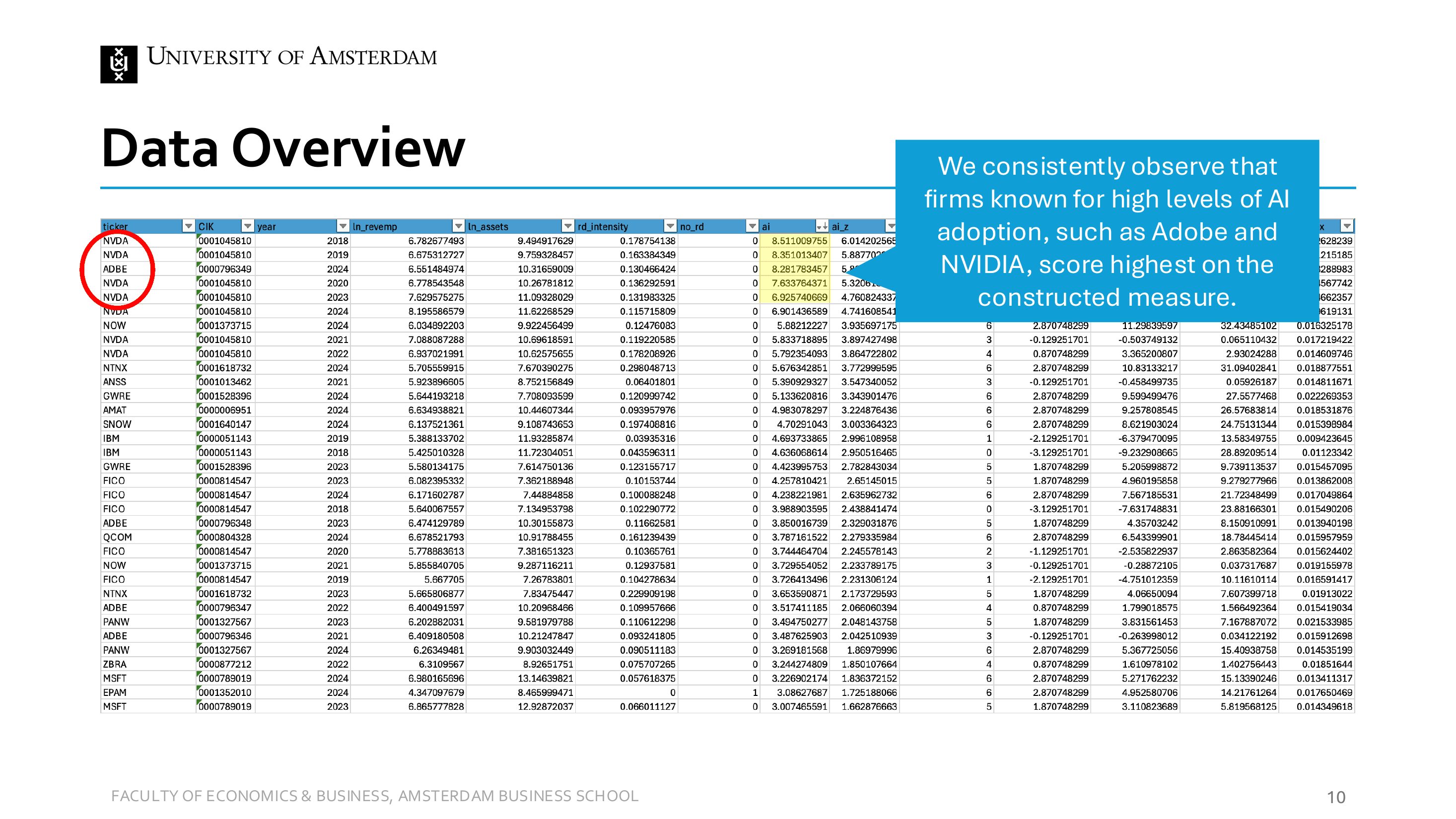
I built a panel of the 89 largest US IT companies from 2018 to 2024. To measure AI adoption, I counted how often AI-related terms appear in each firm's annual 10-K filing, relative to the length of the document. Productivity was measured as revenue per employee.
I used fixed-effects regressions, which compare each firm with itself over time and control for economy-wide shocks. On top of that I added time interactions, so the effect of AI could bend over the years instead of being forced into a straight line.
04Execution
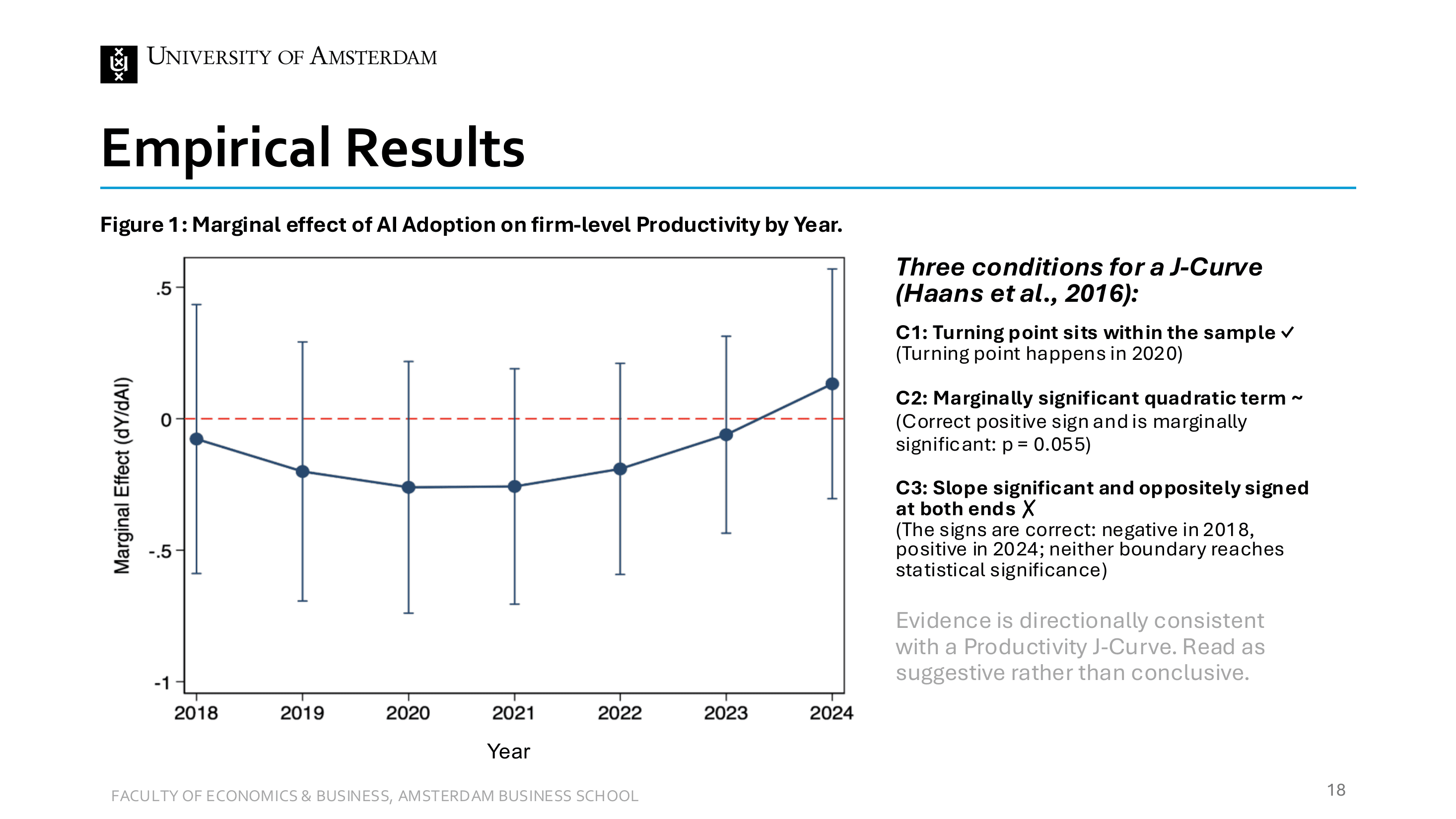
To judge whether the data really shows a J-curve, I applied a formal three-condition test (Haans et al.), which hadn't been done in AI productivity research before. I also re-ran the results excluding the heaviest AI adopters, excluding firms without R&D spend, and with alternative model specifications.
Selected creatives
05Impact
- US IT firms analysed
- 89
- Seven-year panel
- 2018–24
- Thesis grade / 10
- 9.0
Adopting AI had no measurable effect on productivity in the same year. Over time, the pattern matched a J-curve: negative early on, a turning point around 2020, then positive by 2024. The evidence is suggestive rather than conclusive, since the key curve term was only marginally significant.
If it holds, AI's dip-and-recovery is much shorter than past technologies: visible within about seven years, where electricity took decades.
The thesis was graded 9.0/10, and I completed the MSc in Business Administration Cum Laude.
06What I learned
An early productivity dip isn't a signal to stop. Payoffs come after the unglamorous work of retraining people and redesigning processes, so judging AI on year-one numbers undercounts it. It's a useful frame for any team making the case for AI.
Next project
Amazon Prime × Pickup
Amazon Prime · 2025